Apar India College

Apar India College of Management and Technology offers MBA/BBA, MCA/BCA, MSc (IT)/B.Sc (IT), MA/BA (Journalism & Mass Communication) degree courses and provides regular classes (Monday to Friday) without charging any tuition fees along with 100 percent free Job oriented courses such as English speaking, Personality Development, Foreign Language, Hardware networking etc. Degrees are awarded by Sikkim Manipal University(SMU) which is a State Govt. University recognized by UGC, Ministry of HRD, Govt. of India. Students have to pay nominal university fee in the form of Demand Draft in favor of Sikkim Manipal University (SMU) payable at Manipal.

Wednesday, September 15, 2010

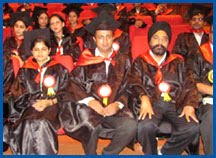
SMU-DE Convocation 2010: The Best Day of Your Life is here…


The biggest day of your life is near. The day when all of Sikkim Manipal University Distance Education(SMU-DE) students participate in the convocation to receive their degrees of excellence and step onto a brand new walk of life. It’s a day that every student wants to experience often but has to be satisfied with the minimal. Nevertheless it is a cherished day for all students and members of SMU-DE that will be remembered for life.
SMU-DE has been a pioneer in the path of practical industry oriented education and its degrees have been recognized as more valuable than those offered by regular colleges. Today as SMU-DE stands chosen as the best distance learning institute of India in terms of teaching efficiency and results and the third best overall, we relish the fact that students of SMU-DE pass out with degrees that work in the real world. It’s no surprise then that SMU-DE students can be found in every industry including the top notch companies such as ICICI Bank, Infosys, HCL, IBM, Wipro, Accenture and Nokia Siemens.
This year SMU-DE has set aside 3 dates for the convocation ceremony spreading across 6 cities. They are September 6 (Kolkata), September 7 (New Delhi) and September 8 (Chandigarh, Ahmedabad, Patna and Guwahati). A host of dignitaries are expected to grace the occasion at these places namely R Ramaraj (co-founder Sify), Rajasekaran Pillai (VC, IGNOU), R C Sobti (VC, Punjab University) and Devanand Konwar (Governor of Bihar).
The importance of graduation and the convocation ceremony for many symbolizes the end of student life at SMU-DE and starting of a new journey as being part of SMU-DE alumni. It’s a ceremony where every student is treated like a celebrity with loved ones and friends waiting to capture the moment. The tossing of the hat marks an exuberance of joy and the transition from students to professionals. Be there to enjoy and savor the moment. After all it’s not a day that comes often and should not be missed.

Wednesday, September 8, 2010

Sikkim Manipal University (SMU) Result July 2010 – SMUDE Results

Sikkim Manipal University (SMU) Result July 2010 or SMUDE Results has been announced on the official website of Directorate of Distance Education Sikkim Manipal University at www.smude.edu.in as SMU DE has been declared its Sikkim Manipal University (SMU) Result July 2010 or SMUDE Results today on September 6, 2010. Candidates can check their Sikkim Manipal University (SMU) Result July 2010 or SMUDE Results or SMU Results of SMU University from the below given links. SMU University has 3 stages of logins its website like Student login, LC login and Edunxt Login to know more information related to Directorate of Distance Education Sikkim Manipal University.
Sikkim Manipal University is the pioneer institute in distance education. The university offers top courses like MBA, MCA, Executive MBA, BBA, BCA, BAJM, MScIT, BCom Prodegree, BScNT Prodegree.
Results have provided at the home page of SMU Website. SMUDE Results can be checked here online by enter their registration number at the space given in following links. Results are available for CEIT, BBA, BBARO, MBA, PGDBA, MBAB, MBABPO, MBAIB, MBAIT, BCOMIS, MCOMIS, PG Dip Specializations.

Friday, September 3, 2010

Distance Learning MBA and Business Management Courses

Distance Education in India
Distance learning MBA and Business Management Courses have become the order of the day with growing number of professionals from diverse fields opting for this mode of study. MBA aspirants and graduates are aware of the lucrative avenues it opens up. Ambitious working professionals seeking career leap often like the idea of pursuing a good distance learning MBA or Business Management course because it gives them the advantage of continuing employment while broadening their knowledge horizons at the same time.

Although there’s nothing that can replace the experience of a full time MBA course given the amount of time you dedicate to acquire theoretical and practical exposure, distance learning mba Courses have increasingly been gaining acceptance in several top line organizations. There are a number of institutes that offer distance learning courses in MBA, PGDM in Business Management.

Are you Eligible for a Distance Learning MBA or PGDM in Business Management course?
Different institutes may have different criteria for admission to their distance learning MBA and Business Management programmes. However, the basic requirements remain the same. Most institutes require the applicant to have bachelor’s degree (10+2+3) from a recognised university. Candidates soon to appear or those awaiting results of their final year examinations can also apply. Diploma holders are also eligible for distance learning MBA and Business Management Courses provided they have adequate work experience.

Students with BBA/BBM degree enjoy the edge of already having got a decent idea about business management. Institutes such as NMIMS make it mandatory for candidates to apply only if they have secured a minimum of 50% marks at the graduation level or have certain years of work experience.


Distance Learning MBA, PGDM in Business Management Courses at a Glance
Distance Learning MBA programmes of the present times are structured in a way to bring out the best of a dedicated learner. Lessons are usually simple to understand and self-explanatory without a compromise on the quality or comprehensiveness of the study material. Many of such courses have gained good credibility in the job market owing to the eligibility norms and assessment methods followed by universities.

If you are seeking answers to questions like what subjects to usually expect in a distance learning MBA/ Business Management course, admission procedure and more, this section is worth a read.

Selecting the Mode of Study: Certain institutes offer a choice of modes to suit individual requirements. They are:
Correspondence mode - Online mode - Distance learning mode

In the correspondence mode, the students are given study materials in self learning format, which they can receive by postal mail. The distance learning mode provides well-designed study materials to students and also offers them the choice of attending classes at Learning centres where in the personal teaching method is practiced periodically. Institutes usually conduct live interactive classes along with mail packages offering study materials to the learners.

Advantages of distance/online learning programmes
Some institutes conduct such classes every Sunday while some others conduct it before the end term exams so that the students can seek clarifications on topics they find dubious. In the online mode, the student is given geographic flexibility and good networking opportunities. Amity School of Distance Learning offers the online MBA programme. This mode cuts geographical barriers and students can also enrol themselves into the online MBA programmes of prestigious international universities.

Course duration: A typical distance learning PGDBA programme is of 2 year duration divided into four semesters. Exceptions can be of universities/institutes offering 3 year distance learning mba Courses divided into six semesters. Institutes generally offer 4-5 years of registration validity from the year of enrolment.

Choosing the specialization: Often, a two year MBA programme focuses on the core subjects in the first year and specialization subjects in the next. Learners will be required to choose their specialization at the time of enrollment. Following are the popular specializations you can consider in a distance learning MBA or business management programme.
Human Resources
marketing - Finance - Operations - Customer Relationship Management
Information Technology - Supply Chain Management

Some institutes name their post graduate diplomas according to the specialisation chosen by the candidate like PGDFM, PGDMM, PGDHR and so on. Project work is usually a part of the last semester of the distance learning MBA and Business Management curriculum based on the specialization opted for.

Core Subjects: Typically, a distance learning MBA curriculum covers about 10-12 core subjects in the first year which explain the basic modalities of management. The core subjects in the first year of the distance learning module are usually from the ones listed below:
Management Theory & Practice
marketing Management
Organizational Behavior
Information Systems Management
Business Economics
Financial Accounting
Corporate Policies & Practices
Essentials of HRM
Project Management
Business law
Business Communication
Quantitative Techniques in Management
Total Quality Management
International Business
Production & Operations Management
Computer Application in Management
Marketing Research
Corporate Governance
Corporate Social Responsibility


Admission Procedure: The candidates can opt for online registration, walk in or postal admission. With the walk-in facility offered by several institutes, the applicant is required to submit the completed application form, registration fee, and necessary documents and he/she can walk out with the admission letter and ID card. Certain institutes have learning centres across the country. The candidate can visit the nearest one and complete the admission formalities.

Similarly, the applicant can send all the necessary documents through post and receive the admission letter and ID card on his postal address. Some institutes provide the online registration facility but prefer the fee payment through demand draft which can be submitted or sent by courier to the institute.

Job Prospects: Gone are the days when distance learning MBA and Business Management degree holders were considered lesser in the competitive job market. Growing credibility of distance learning mba Courses from reputed institutes, which now focus on application of theory to practice and familiarizing the student with the real corporate world, has lead to the qualified alumni being absorbed in sectors such as marketing, Retail, Human Resource, Project Management, Banking, Information Systems, Healthcare Services, Finance Management, Quality, and others. For distance learning management graduates, the dream of having a career as Human Resource Manager, Project Manager, marketing Executive, Supply Chain head, Project Supervisor, Project Manager, Operations Manager, or Accounting and Resource Manager is not so unrealistic anymore!


Distance Learning MBA – The Obvious Edge
The above-mentioned institutes offer quality learning material for MBA aspirants. Usually the learning material is self-explanatory and requires minimum guidance. The institutes conduct personal contact programmes periodically for students wishing to obtain more information on topics they find dubious. Such personal contact programmes are great for learners because they get to experience the classroom environment where they can interact with fellow learners and lecturers and seek clarifications on lessons they need help on. Besides, the flexibility offered by such distance learning MBA programmes is great for working professionals.

Source : http://www.minglebox.com/

Monday, June 14, 2010

BBA from Sikkim Manipal University Vs. B Com Subject from Delhi University #1


Summary: There has been an ongoing debate for some years now–Which course is better ? BBA from Sikkim Manipal University Or B.Com from Delhi University? It's a subjective topic and hence, varied opinions on the same. After reviewing the experiences of thousands of students across the length & breadth of the country, we've attempted to weigh both the courses across some common parameters. Read on to find what we have to say on this!


Once students are done with their 12th standard examinations, they look forward to better and lucrative career options. However, they often find themselves landed up in dilemma when it comes to choosing courses of specialization. The confusion is all the more serious for students of commerce stream. Which course to choose? BBA or B.Com? Once clear about the course, another confusion pops up--which institution to choose?


In this article, we have tried to highlight the comparitive analysis of two courses— BBA from Sikkim Manipal University and B.Com from Delhi University.


To begin with, management education has evolved remarkably in India. A number of good management education institutions have surfaced addresing the ever increasing demands of varied UG & PG management courses in India. Since our country has witnessed a sound economic development pace over the last decade, management education has been well received by the students and the job sector. Many of the top Indian Universities today offer BBA course, which is almost like a gateway to pursue higher management course & eventually become efficient managers.


The management courses can be pursued full-time, part time or distance learning. Sikkim Manipal University offers BBA, which is a carrer-oriented management degree. If a students wants to explore challenging & dynamic career, this degree is apt to get started with. This course encompasses all major concepts such as economics, finance, statistics, strategy, marketing, organizational behavior & management etc., which are applicable to the current corporate world.


On the other hand if we talk about B.Com from Delhi University, it is an undergraduate business management degree that (unlike BBA from Sikkim Manipal University) highlights more on theoretical business aspects & corporate principles besides case studies, micro economics, corporate accounting, income tax, fundamentals of investment etc.


Now it's the right moment to dicuss the key objectives of each of these courses. Broadly speaking about the key objectives of BBA from Sikkim Manipal University, this program is an amalgamation of three core management disciplines of communication, leadership and decision making & problem solving. However when we talk about B.Com course from Delhi University, the key objective seems to be making the student enhance his/her knowledge base of business-centric concepts and principles.


Now let us turn our eyes to the other aspect of these two courses—Eligibility criteria. When we talk about BBA from Sikkim Manipal University, the pre-requisite for getting admission is to have a 10+2 or equivalent degree/3-year diploma from the State Board of Technical Education. In case of B.Com degree from Delhi University, the eligibility criteria is 10+2 degree.


Keep reading our subsequent articles for gaining a deeper insight into the details associated with BBA (from Sikkim Manipal University) and B.Com (from Delhi University).

Source: http://besteducationcoaching.blogspot.com/

BBA from Sikkim Manipal University Vs. B.Com Subject from Delhi University #2

BBA from Sikkim Manipal University Vs. B.Com Subject from Delhi University #2

Summary:In our last article, we discussed the key objectives of the two management courses— BBA from Sikkim Manipal University and B.Com degree from Delhi University. In this write-up, we would be discussing some more key aspects of these courses so that students like you get a better idea about which course to choose.


Well having dicussed the core objectives of both the courses-- BBA from Sikkim Manipal University and B. Com degree from Delhi University—it's time to focus on other parameters of these degrees.


If we talk about the duration of BBA from Sikkim Manipal University, the minimum tenure of this course is 3 years. Since it is a distance learning course, it can be pursued for upto a maximum time period of 6 years. This distance learning program has an edge over the other degree (B.Com from Delhi University) since even if you miss out on appearing in the examination of one or more semesters, you can reappear in the next term since you have an ample time to finish your course in 6 years. However speaking about the duration of B.Com from Delhi University, the duration of this course is strictly 3 years.


Let us discuss the structure of each of thes two courses.


To begin with BBA from Sikkim Manipal University, it's a course divided into 6 semesters. Each semester has distinct subjects to be covered by students. For instance, Semester 1 entails subjects such as Marketing, Organizational Behavior, Communication Skills, Financial Accounting and Computer Fundamentals. Semester 2 covers subjects such as Management Information Systems (MIS), Legal Regulatory Framework, Business Strategy and Financial Resources Management. Semester 3 encompasses subjects like Management Accounting, Financial System & Auditing, Quality Management and Small Business Management.


Semester 4 covers subjects such as Financial Reporting, Human Resources Management, Taxation, Managing Information, Production and Operation Management. Semester 5 is inclusive of subjects like Capital & Monetary Market, MNCs & their roles, Online Marketing, E-Commerce and Technology Management. Semester 6 includes subjects such as Cross-culture aspects of Business, Entrepreneurship Development, Economic Reforms Process in India, Roles of International Financial Institutions and Management Development.


Having talked about th structure of the degree BBA from Sikkim Manipal University, it's time for us to have a glance at the structure of B.Com degree from Delhi University. B.Com is a 3-year degree course divided into yearly syllabus, and the scheme of grading is annual unlike BBA from Sikkim Manipal university, which has semester wise grading scheme. Well, the subjects covered in B.Com degree from Delhi University are enumerated as below:


Year 1: BO&M, Financial Accounting, Micro Economics (I), Business Statistics, Business Law, Introduction to Computers, Business Communication, Politics, Ethics & Social Responsibility.


Year 2: Corporate Accounting, Cost Accounting, Micro Economics (II), Business Mathematics, Corporate Law, Income-tax, E-commerce, Auditing, MIL : English/Hindi


Year 3: Management Accounting, Macro Economics, Indian Economics, Optional Groups—EA inclusive of Financial Management, Fundamentals of Investment etc. EF inclusive of Corporate Tax Planning and Business Tax Procedures & Management.


After having analysed the course structure, it is quite evident that BBA from Sikkim Manipal University outpaces B.Com from Delhi University since the former focuses more on the practical aspects of business administration & management. However, the latter emphasizes more on theoretical aspects of business management.


Stay tuned for our subsequent articles to gain more in-depth knowledge about the degrees--BBA (from Sikkim Manipal University) and B.Com (from Delhi University).

Source: http://besteducationcoaching.blogspot.com/

BBA from Sikkim Manipal University Vs. B.Com Subject from Delhi University # 3

Summary:
In our last article, we focused on some important parameters of the two degrees-- BBA from Sikkim Manipal University and B.Com degree from Delhi University—tenure & syllabus covered in each of them. In our latest attempt, we would be giving you some more information about these two courses, whih would help you take the right decision for your career.


After enlightening you on some key parameters such as objectives, eligibility criteria, tenure and course structure of the two degrees--BA from Sikkim Manipal University and B.Com degree from Delhi University—we find that this is an apt juncture, where we should highlight you on some other important parameters associated with these degrees.


To start with the fee structure of B.Com from Delhi university, the fee needs to be paid on an annual basis, and it is somewhere between Rs. 3,000—Rs. 4,000 for each year. In addition to this, the students also needs to pay a meagre amount of Rs. 200—300 as library and other maintenance charges. This nominal amount is refundable, and can be taken back at the completion of course.


However if we talk about BBA from Sikkim Manipal university, the fee is around Rs. 10,450 per semester, which is inclusive of Exam free (Rs. 800) and Alumni Fee (Rs. 100). This fee structure is revised from time to time.


Looking at the comparitive fee structure of the two courses, you might feel a bit nervous and confused about which course to opt since reading our previous articles of the series, the picture would have become somewhat clear by now. However, we recommend you not to be so perplexed since you need to look at the bigger picture & pursue a course that might put a temporary strain on your pocket but opens a gateway to great career opportunities in the longer run.


Once you've cleared your airs of confusion about which course you're likely to choose now, it's our duty to educate you about the career opportunities or future programmes associateed with these two courses.


If we look at the study tends, it is interesting to note that BBA from Sikkim Manipal University has yet again an edge over B.Com from Delhi University. In the last couple of years, more & more students have shown their increasing interest in optiong for this distance learning course. On interviewing some of the students an amazing concept has surfaced, which highlights that even after being awarded with B.Com degree, students don't feel confident to put their feet forward in the competitive scenario or even when they appear for entrance examinations of higher management degrees. The students feel that they have acquired the degree but no real learning.


However, the students who have already completed BBA degree from Sikkim Manipal University have a different story to tell. They feel that they took the right decision to have opted for this course since it has given them the right measure of confidence, learning and aptitude to either go for higher management studies or even step out and become successful managers. Also, some students praised this degree highly since they could manage to complete their degrees in a right way within the extended period of 3 more years in spite of some unavoidable circumstances/failure in any semester during the course.


To conclude, we would recommend BBA degree from Sikkim Manipal University to all the 12th Standard pass outs of this year & forthcoming batches. It would be a right career move. Trust on this one!


Source: http://besteducationcoaching.blogspot.com/

Saturday, May 29, 2010

WHAT AFTER 10+2? -CONFUSED -NO WORRY

WHAT AFTER 10+2? -CONFUSED! -NO WORRY

DID YOU KNOW?

PROFESSIONAL COURSES BBA/BCA WITHOUT TUTION FEE MADE EASIER AT APAR INDIA

If not please go through this news item which will give an insight to those parents who want their wards to be more self sufficient and self competent in their future careers and those students who could not get enrolled in any university colleges for any degree courses, but have fire in their bellies and want to take up the challenging step to pursue professional courses like BBA, BCA, can have a ray of hope to fulfill their long standing ambitions with APAR INDIA COLLEGE OF MANAGEMENT & TECHNOLOGY.

It has become an open secret that learned parents as well as enthusiastic 10+2 students irrespective of their % can pursue higher education by opting for professional courses like BBA (Gen) - BBA (Retail)-BCA-B. Sc (IT)-BA (Journalism) - MBA (Finance-Marketing-HR-Information System-TQM-Retail Operations-Project Mgt-Operation Mgt) at APAR India College of Management and Technology Sector-8 Rohini Delhi-85.

Nowadays people are becoming more education oriented and they know what their children should study after 10+2. Many learned parents are inspiring their children to opt for professional courses in regular stream or through correspondence (distance education) in any B school or any Institute of Management Studies. Even students have realized that possessing a professional degree helps them to have the cutting edge in the future when they compete with other students with general graduation for the jobs.

But to get direct admission to any professional course BBA-BCA-B.Sc-BA(J)-MBA by paying nominal University fee without paying any extra tuition fee is not possible anywhere, but it is possible only in APAR India College and this is true 100%. Present education system is so vast and it has paved ways for more career oriented and growth oriented courses, streamlined the general educational background up to 12th standard thereafter pursuance of professional courses.


But it is unfortunate that many parents still guide their wards to study degree courses like BA B Com etc in any university colleges with a belief that award of degree with university stamp will pay more dividends when they enter the job market but only time will tell what is stored in their fate. Because they do not know corporate world which is more vibrant and gives importance to professional course degree holders, whom the corporate pundits think more knowledgeable and competent to withstand any odds in the management scenario.


While the innovation in every sphere of life is the hallmark and buzzword people in the society are also changing their lifestyle and are moving forward accordingly in their day to day life span. It is advisable here that in the era of competition where students after their secondary education should opt for computer education course being imparted by private institutes like JETKING, NIIT, DOAECC, DICS to become self sufficient to attain self competency in their sphere. Similarly there are some students lured by private institutes BSL-OXFORD and VETA.


Also there is no dearth of students who aspire to attain proficiency in foreign languages like German, French, Spanish, Japanese, by pursuing foreign language studies in any of recognized institutes to take up translation work or transcription work easily which will get gainful employments.

Today Multi National Corporations (MNCs) prefer to hire those students who have equipped themselves with BBA BCA MBA MCA degrees (either through regular or distant education) who, they opine possess soft skills with vibrant managerial skills and are more competent to man the industry as well as employees. Keeping in view of this tendency many students want to upgrade their professional skills by undergoing professional courses, Personality Development, Total Quality Management skills. Also it is the desire of students to possess knowledge in tallying, Basic Book Keeping and Basic Accounting so that they can move laterally or horizontally or vertically in job market and will get success.

Union Education & HRD Minister Mr. Kapil Sibal has made it clear that ‘today there is no dearth of lucrative jobs in India, but there is dearth of skilled professionals’. He opines that today corporate world desire to hire such skillful talents and heads who are competent, possess soft skills equipped with professional degrees. Here he emphasized in some of his addresses that mere possession of professional courses degree will not in any way guarantee the availability of jobs but they should have mastered the professional skills to withstand any odds, which is the intrinsic value of their overall competency.

But nowadays in never ending process many B schools, institutes of management studies, institutes of management education are mushrooming in every nook and corner of the country and beckoning gullible students towards them with their fee structures and assure many things during the time of admission but in the end some of the promises will not get fulfilled – may be due to lack of interest or lack of skills among students. That is why today students are running hither and thither to gain knowledge in different places by paying hefty fee and spend more of their precious time.

But if all these skills, education and training will be available under one roof then it will become paradise for any aspirant. Students will not only save their hard earned money but also their precious time at minimum investment. Even if they shell out more money to attain lucrative job they may not be able to fetch such job due to lack of professional course degrees. Therefore it is advisable in all hypes and buzz, aspirants should focus themselves to join such institute of management studies which can provide direct admission to any professional course without exorbitant fee but nominal university fee inclusive of exam fee and study materials).

Keeping in view of all these objectives APAR INDIA College of Management and Technology situated in Sector-8 Rohini having its campus at Rohini and Dwarka sector 19 with built-in state-of-the-art infrastructure facilities and first ever Management College in the country to be ISO 9001-2008 certified, is dedicated to students’ overall success and rendering its yeomen service to the humanity.


APAR India College of Management and Technology offers professional courses like BBA (general), BBA (Retail) BCA, B.Sc (IT) B.A(Journalism) (all are three years duration) and MBA (Two Years) MCA (Three Years) and MA (Journalism-2 years) for throw away fee which is very nominal compared to other institutes and award university degree certificate.

Besides imparting education in accordance to the University’s curriculum, students gain the functional and industry specific knowledge at APAR INDIA which helps them to get prepared and become valuable contributors to the industry. As a result, the graduated students of APAR INDIA are employed in top multi nationals in India. It offers high quality programs in different areas of management to a wide cross section of students, executives and professionals across northern India.

Case-based learning is an important component of business education at APAR INDIA and most of the courses are taught through real life cases designed to help bridge the gap between management theory and practice.

For further information any student can contact the Institute at Tel. No. 4504-4000 (Rohini). Dwarka campus: 45607500. Or they can visit APAR’s website: www.aparindiacollege.com and blog at www.aparindiacollege.blogspot.com and they can also get any information by mailing their queries to e-mail ID: info@aparindia.in.


Apar Weblink:http://www.aparindiacollege.com/index.htm
WHAT AFTER 10+2? -CONFUSED! -NO WORRY

DID YOU KNOW?

PROFESSIONAL COURSES BBA/BCA WITHOUT TUTION FEE MADE EASIER AT APAR INDIA

If not please go through this news item which will give an insight to those parents who want their wards to be more self sufficient and self competent in their future careers and those students who could not get enrolled in any university colleges for any degree courses, but have fire in their bellies and want to take up the challenging step to pursue professional courses like BBA, BCA, can have a ray of hope to fulfill their long standing ambitions with APAR INDIA COLLEGE OF MANAGEMENT & TECHNOLOGY.

It has become an open secret that learned parents as well as enthusiastic 10+2 students irrespective of their % can pursue higher education by opting for professional courses like BBA (Gen) - BBA (Retail)-BCA-B. Sc (IT)-BA (Journalism) - MBA (Finance-Marketing-HR-Information System-TQM-Retail Operations-Project Mgt-Operation Mgt) at APAR India College of Management and Technology Sector-8 Rohini Delhi-85.

Nowadays people are becoming more education oriented and they know what their children should study after 10+2. Many learned parents are inspiring their children to opt for professional courses in regular stream or through correspondence (distance education) in any B school or any Institute of Management Studies. Even students have realized that possessing a professional degree helps them to have the cutting edge in the future when they compete with other students with general graduation for the jobs.

But to get direct admission to any professional course BBA-BCA-B.Sc-BA(J)-MBA by paying nominal University fee without paying any extra tuition fee is not possible anywhere, but it is possible only in APAR India College and this is true 100%. Present education system is so vast and it has paved ways for more career oriented and growth oriented courses, streamlined the general educational background up to 12th standard thereafter pursuance of professional courses.


But it is unfortunate that many parents still guide their wards to study degree courses like BA B Com etc in any university colleges with a belief that award of degree with university stamp will pay more dividends when they enter the job market but only time will tell what is stored in their fate. Because they do not know corporate world which is more vibrant and gives importance to professional course degree holders, whom the corporate pundits think more knowledgeable and competent to withstand any odds in the management scenario.


While the innovation in every sphere of life is the hallmark and buzzword people in the society are also changing their lifestyle and are moving forward accordingly in their day to day life span. It is advisable here that in the era of competition where students after their secondary education should opt for computer education course being imparted by private institutes like JETKING, NIIT, DOAECC, DICS to become self sufficient to attain self competency in their sphere. Similarly there are some students lured by private institutes BSL-OXFORD and VETA.


Also there is no dearth of students who aspire to attain proficiency in foreign languages like German, French, Spanish, Japanese, by pursuing foreign language studies in any of recognized institutes to take up translation work or transcription work easily which will get gainful employments.

Today Multi National Corporations (MNCs) prefer to hire those students who have equipped themselves with BBA BCA MBA MCA degrees (either through regular or distant education) who, they opine possess soft skills with vibrant managerial skills and are more competent to man the industry as well as employees. Keeping in view of this tendency many students want to upgrade their professional skills by undergoing professional courses, Personality Development, Total Quality Management skills. Also it is the desire of students to possess knowledge in tallying, Basic Book Keeping and Basic Accounting so that they can move laterally or horizontally or vertically in job market and will get success.

Union Education & HRD Minister Mr. Kapil Sibal has made it clear that ‘today there is no dearth of lucrative jobs in India, but there is dearth of skilled professionals’. He opines that today corporate world desire to hire such skillful talents and heads who are competent, possess soft skills equipped with professional degrees. Here he emphasized in some of his addresses that mere possession of professional courses degree will not in any way guarantee the availability of jobs but they should have mastered the professional skills to withstand any odds, which is the intrinsic value of their overall competency.

But nowadays in never ending process many B schools, institutes of management studies, institutes of management education are mushrooming in every nook and corner of the country and beckoning gullible students towards them with their fee structures and assure many things during the time of admission but in the end some of the promises will not get fulfilled – may be due to lack of interest or lack of skills among students. That is why today students are running hither and thither to gain knowledge in different places by paying hefty fee and spend more of their precious time.

But if all these skills, education and training will be available under one roof then it will become paradise for any aspirant. Students will not only save their hard earned money but also their precious time at minimum investment. Even if they shell out more money to attain lucrative job they may not be able to fetch such job due to lack of professional course degrees. Therefore it is advisable in all hypes and buzz, aspirants should focus themselves to join such institute of management studies which can provide direct admission to any professional course without exorbitant fee but nominal university fee inclusive of exam fee and study materials).

Keeping in view of all these objectives APAR INDIA College of Management and Technology situated in Sector-8 Rohini having its campus at Rohini and Dwarka sector 19 with built-in state-of-the-art infrastructure facilities and first ever Management College in the country to be ISO 9001-2008 certified, is dedicated to students’ overall success and rendering its yeomen service to the humanity.


APAR India College of Management and Technology offers professional courses like BBA (general), BBA (Retail) BCA, B.Sc (IT) B.A(Journalism) (all are three years duration) and MBA (Two Years) MCA (Three Years) and MA (Journalism-2 years) for throw away fee which is very nominal compared to other institutes and award university degree certificate.

Besides imparting education in accordance to the University’s curriculum, students gain the functional and industry specific knowledge at APAR INDIA which helps them to get prepared and become valuable contributors to the industry. As a result, the graduated students of APAR INDIA are employed in top multi nationals in India. It offers high quality programs in different areas of management to a wide cross section of students, executives and professionals across northern India.

Case-based learning is an important component of business education at APAR INDIA and most of the courses are taught through real life cases designed to help bridge the gap between management theory and practice.

For further information any student can contact the Institute at Tel. No. 4504-4000 (Rohini). Dwarka campus: 45607500. Or they can visit APAR’s website: www.aparindiacollege.com and blog at www.aparindiacollege.blogspot.com and they can also get any information by mailing their queries to e-mail ID: info@aparindia.in.


Apar Weblink:http://www.aparindiacollege.com/index.htm

Monday, May 10, 2010

Varsities facing de-recognition get a reprieve

Varsities facing de-recognition get a reprieve


New Delhi: The Supreme Court (SC) has allowed the 44 deemed universities whose recognition is at stake to accept fresh students, despite strong objections from the human resource development (HRD) ministry.
The apex court dismissed on Thursday a plea by the HRD ministry that the universities, indicted by the Tandon Committee last year, be restrained from admitting new students.
A bench of justices Dalveer Bhandari and Gyan Sudha Mishra pointed out that the very basis of the Tandon panel had been questioned, thus it wouldn’t be appropriate to pass any prohibition order against the universities, which the Centre sought to de-recognise.
The court will hear the matter on August 3. It asked the parties concerned to fileaffidavits and responses by then.
SC also rejected solicitor general Gopal Subramanium’s argument that at least a condition be imposed on the disputed universities that they would abide by the court’s judgment and fresh admissions would be subject to that decision.
The apex court had on April 13 decided to examine the core issue of whether the government had the power to drop the “deemed” status of the 44 universities.
Union HRD minister Kapil Sibal had in October last year issued notices to the universities after a review committee headed by professor PN Tondon recommended dropping of their “deemed” status on the ground that they had failed to meet the standard required for sustaining the status.
The panel said the universities were being run as family fiefdoms, rather than as institutions of academic excellence, which they claimed to be.
Sibal had also announced formulating a national commission for higher education and research bill to scrap the concept of deemed universities.
There was a hue and cry as the future of about 1.5 lakh students had been put at stake.
The task force then recommended that the failed institutions, which were earlier colleges or state affiliated universities, should be reverted to their original positions and all the students enrolled there must be allowed to complete their studies there.

Source Link: http://www.dnaindia.com/academy/report_varsities-facing-de-recognition-get-a-reprieve_1380050

Apar Weblink:http://www.aparindiacollege.com/index.htm

Toppers over the moon in Bangalore, aim higher

Toppers over the moon in Bangalore, aim higher


Bangalore: For toppers of the SSLC 2010 examinations, the results announced on Thursday are the first step towards pursuing their dream jobs.
Apoorva J, from AV Education Society, JP Nagar, Bangalore, was not surprised at all when she heard of her top-class performance in the exams.
“I really expected those marks, but I didn’t know I would be the topper. In the school preparatory exams, I consistently got 616, 617 and 619. I am very happy,” beams a visibly confident Apoorva, who scored a high 619 out of 625 marks, one of only three this year who have scored the near-perfect marks.
Apoorva had received an award during her school graduation day for securing the highest marks in all subjects in the school-level exam. She aspires to be an IAS officer. But before that she wants to get into engineering graduation.
“I have decided to take up science (PCME subjects). I plan to do my graduation in engineering and want to be an administrator by clearing the IAS examinations,” she told DNA.
Her formula for a good score? “There’s no point in studying 8-10 hours a day. I used to study for 3-4 hours a day. I prefer to study at night,” Apoorva said. Vijaya Composite or Junior College is her first choice of college, she said.
Aishwarya Rajiv from Sadvidya School, Mysore, who also scored 619 marks, unlike Apoorva, is pleasantly surprised with her achievement.
“I am really surprised that I am one of the toppers. I want to thank my parents and teachers who supported me. My school conducted more preparatory exams which helped me to score well,” said Aishwarya. She wants to be a doctor and has decided to take up science (PCMB) in PUC.
DNA also spoke to a few students who passed with distinction. Abhishree S who scored a total of 600 out of 625 is from AV Education Society, JP Nagar, Bangalore. “I had not expected this result and I am really happy with it,” she said. Abhishree wants to be an engineer.
She is also glad that her school mate, Apoorva, is among the three toppers in the examination. Another top scorer is Pavani Acharya, with 607 marks in her kitty. From Carmel Convent High School, Jayanagar, Pavani wants to join Christ College and take up commerce. “In my family, we have many engineers. I want to do MBA,” said Pavani.

Source Link: http://www.dnaindia.com/bangalore/report_toppers-over-the-moon-in-bangalore-aim-higher_1379649

Apar Weblink:http://www.aparindiacollege.com/index.htm

There is a lot to be learnt from Indian cos: Nitin Nohria

There is a lot to be learnt from Indian cos: Nitin Nohria

MUMBAI: Harvard Business School (HBS) may not build a campus in India, but it is committed to expanding its presence and reach through its research centre, which is creating intellectual capital that can be widely used in other parts of the world, said Nitin Nohria. The newly-appointed dean of HBS said management education is best derived from actual practises of managers and there is a lot to be learnt from Indian companies.

“We have written over 50 case studies on Indian companies for use in the classrooms at Harvard,” said Mr Nohria, in a telephonic interview. “They offer learnings on how companies build large-scale distribution systems, how they set up systems for recruiting that touch a vast number of people, and how they fill institutional voids.”

Asked what his policy agenda would be, the new dean said that it would emerge from discussions with colleagues and students in the coming weeks. “But I do know my priority is to make this a period of innovation at Harvard. We want to be a beacon for education and create business leaders for the next century.” HBS is already experimenting with different kinds of pedagogy, including immersion programmes that send students out to different countries and different industries. But there’s no plan to move away from its trade-mark case study pedagogy. “The innovations we’re introducing will complement the case study method and we hope they will be as sticky as the case study method.”

His new responsibilities notwithstanding, Mr Nohria hopes he will be able to continue teaching. “I’d be very sad if I were disconnected from the classroom. My first love has always been teaching, and I intend to do everything I can to stay connected with students and the classroom.”

Last year, he introduced a mandatory course for first-year course students called ‘Leadership & Corporate Responsibility.’ It’s a theme he’s passionate about and he’s even propounded the idea of a kind of Hippocratic Oath for business. “I believe business has a vital role to play in society and it needs to be conducted with honour,” he said. “In the past few years, society has lost faith in business because it has let short-term profit overshadow long- term interests. We’ve been trying to get our students to understand this. They have to see their careers as a marathon, not a sprint. This means contributing to the world, not just your own life.”

IIT-Bombay gave him a fabulous education, he said, providing life-lessons that have served him well in his career. “The IIT taught me to survive anything. Being in the USA was challenging in the initial years and my IIT experience really helped. We should be proud of the IITs and what they do for their students.”

Mr Nohria considers the Indian-American immigrant experience to be similar to that of immigrant communities that came to the USA before, a subject that he has explored in his book Paths To Power: How Insiders and Outsiders Shaped American Business Leadership. “I’m proud to be an American citizen,” he said. “We all started off in a few narrow fields like medicine, engineering and teaching, but Indian-Americans now see opportunities in all walks of life, from Hollywood to literature to politics. My father taught me to follow my passion and that’s the advice I give my students.”

That’s actually a standard piece of advice. But Mr Nohria’s most important life-lesson, the one he passes on to his students in the very last classroom session on every course he takes, is something else. He talks to them about generosity: “Life gives it all back to you in more ways than you can imagine.”

Source Link: http://economictimes.indiatimes.com/news/news-by-industry/services/education/There-is-a-lot-to-be-learnt-from-Indian-cos-Nitin-Nohria/articleshow/5900359.cms

Apar Weblink:http://www.aparindiacollege.com/index.htm

Girls continued to outshine boys in SSLC-2010

Girls continued to outshine boys in SSLC-2010

The score card reads 619 out of 625—that’s the top score in this year’s SSLC exam, Karnataka. Three students, two from Bangalore South and one from Mysore, have cracked this score. An overall pass percentage of many students has been 63.56% in this exam.
The new model introduced by the Karnataka Secondary Examinations Evaluation Board (KSEEB) gives more weightage to descriptive answers than to multiple choice questions. The results have been satisfactory this year.Of the total of 8,20,778 candidates who had appeared for the SSLC examinations held last month, 5,21,658 candidates passed.
There’s been a rise and dip in the pass percentage in the previous years. In 2008, it fell to 66.37% and in 2009, it crossed the 70% mark with 70.22%. The students taking the exam this year were under pressure owing to the new exam pattern. Till 2009, students could score 60% marks in multiple choice questions, an easy scoring option versus the new pattern, which reserved 75% marks for descriptive answers. As compared to last year’s overall pass percentage of 75.77, this year only 68.77 per cent of the 8, 20,778 students who had appeared for the exams passed. The success rate is the lowest in the last four years.However, girls continued to outshine boys this year, too, with their pass percentage standing at 70.97 per cent as compared to 66.67 per cent among boys.
SSLC examinations were held at 2,895 centres across the state. The Evaluation started on 15 April 2010 with 39,000 evaluators.


Source Link: http://www.minglebox.com/article/mba/Girls-continued-to-outshine-boys-in-SSLC-2010---/data-0001-fdbffe73286a0bf701286bf69c5b0da6


Apar Weblink:http://www.aparindiacollege.com/index.htm

'Choose the subjects that you like most'

'Choose the subjects that you like most'


Bangalore: Dr BS Jayashree, principal, Vijay PU College, has some words of advice for students who are wondering what courses to choose after the SSLC. “The SSLC 2010 results are out. This is the stage when students are expected to make a choice of subjects for further study. The best way to make that decision is to examine your own interest and aptitude, and to choose the subjects you enjoy most.”
It has been a pattern across the country over several years: students who score the highest marks often opt to study science, which is considered necessary study for entry into the most prestigious professions. “However, so much of the higher education in science depends on a sound understanding of basic concepts. Even if the score in the SSLC is high, many students find themselves in a tight spot at higher levels, as the syllabi in the science subjects even in the pre-university level is so different,” says Dr Jayashree.
“A science student needs to be disciplined and methodical,” says Dr Jayashree, adding that although science was for long considered the most prestigious course, Commerce subjects too offer challenges. Medicine and engineering are no longer the only professional fields that make for a secure income; those with a variety of educational backgrounds now have a range of options, she says.
Repeating that oft-cited reason for studying the Arts subjects, Dr Jayashree says, “Those who would not like to face a great deal of pressure in studies can opt for the Arts. Subjects like Sociology and Psychology open up whole new areas for students.”

Source Link: http://www.dnaindia.com/academy/report_choose-the-subjects-that-you-like-most_1379647

Apar Weblink:http://www.aparindiacollege.com/index.htm

Wednesday, May 5, 2010

Apar India

Apar Inida

Apar India Institute full of Advantages

Apar India Institute full of Advantages

Apar India Institute is the brainchild of Mr. Raj Kumar Jain. He is the founder of the "Apar India College of Management and Technology.” The institute is located at Dwarka and second center at Rohini. Within the short spam of time the institute has created a special place for itself in the list of B-Schools. Apar Institute is famous among the students because of many reasons. It has many salient features which makes it different from others.

Apar Institute is well located and connected by the local transport. Both the centers of the institute are well connected by Delhi Metro. The distance of the institute from the metro station is just few minutes walk. This is the big advantage for those students who live in North or in West Delhi, they can easily commute. To commute for a longer distance might be the problem for some, but with Apar institute you have the facility that you can easily reach there without any baffle.

Beyond this there are many more advantages you can enjoy being there. Being a management student you suppose to pay a hefty amount as fee. But, here in Apar the institute charges no tuition fees from students. The institute offers you the best conducive environment for education and without charging any tuition fees. This innovative initiative is taken by the institute for the students. Charging no tuition fees from students and giving them education free of cost is really a milestone in the history of the education. No institute has ever taken such a great step for the benefit of students. Presently, most of the institutes charging big amount from students as their fees for the course. But, Apar has changed this trend and charging no fees from the students like other government colleges, where you need not to pay tuition fees.

Some students might get confused if the institute is not charging any fees from students then it might not be upto the level of other B-Schools. In case of the Apar Institute, it is envy for other colleges because it offers you the best infrastructure facilities and modern teaching aids like: air-conditioned lecture theatres, classrooms, seminar halls, an auditorium along with audio/video facilities, LCD projector, vast Computer labs, a well-stocked library with a rich collection of reference books of various subjects. The institute caters all the requirements of the students. The faculty of the institute is renowned and expert of their respective field. Here, every student gets ample opportunity to groom and prepares themselves to face the challenges of the professional world. The placement cell of the institute is also very active. The companies from all over the country came here to recruit the students. Some of the big names like: GAIL, Mother Dairy, Indian Oil Corporation Limited, IBM, Birla Soft, MTNL, HDFC Bank Ltd., Indian Air Force, Eureka Forbes and Seimens etc. are in the list of the recruiters of the campus. Every year most of the students get placed in good companies and most of them are earning good salary.


Apar Weblink:http://www.aparindiacollege.com/index.htm

Tuesday, April 27, 2010

A Career and a Choice

A Career and a Choice


And so I became a doctor although I would rather have been a journalist. But because my heart wasn't with the profession, I soon outgrew this and became a part of the charitable non-profit sector where I have spent most of my years.

WHEN I was a young student, most of the people did not have many career choices. Usually the children chose to do what their parents did before them – so lawyer’s children were encouraged to be lawyers, a teacher’s children to be teachers and so on. And if the parents were none of these and wanted something different for their children, they would push their children to become a doctor or an engineer or a civil servant. In those times these and a few others were considered to be aspirational careers which parents encouraged their children to strive for. The children’s own wishes were of little consequence. If you have seen the movie, 3 idiots, you would notice that such a tradition still exists.

And so I became a doctor although I would rather have been a journalist. But because my heart wasn’t with the profession, I soon outgrew this and became a part of the charitable non-profit sector where I have spent most of my years. And while working in an NGO, I have seen an amazing variety of people who were trained to be something else but ended up with something quite different. As the head of an organization which deals with women and children who have been trafficked, I have a team which is full of people who were trained to be something but are finding themselves driven by a passion for something else.
Today the choices and options available to young people are many. So, parents are happy to leave the choice of a viable career option with their children, but youngsters often find it difficult to make a choice. They are caught between peer pressure, the materialistic values that increasingly guide the society and the inner calling and vocation whose voice often gets muffled out.

As we consider various career options and courses for study, the singular question to ask ourselves is: “Will this help me become a better servant for others?” Our choice of a job or a career in life should be about how we can best serve our family and others with the gifts and abilities God has given us. If our whole focus in choosing a job or career is only about getting rich and serving ourselves, then we are making sinful choices. There was a time when certain professions, subjects of study and vocations were considered holier than others. Those who pursued that path were considered set apart for “full time” work. But today we know that whether we serve as a pastor or serve in a coal mine as a technician or as a Air Traffic Controller at the airport, as long as through our studies and jobs, we are able to fulfill our responsibility of stewarding this created world in a God honoring way, we are doing fine.

William Sloane Coffin, a former chaplain of Yale university speaks to our own challenge of responding to God’s call, of choosing the pathway of faithful living, when he reminds us, “A career seeks to be successful, a calling to be valuable. A career tries to make money; a calling tries to make a difference.”

The fact is that, no matter what we do for a living, it’s about serving others. Whether we work at a Café Coffee Day outlet or are a CEO in a big company; whether we are a doctor or a garbage collector, we should do our job the best we can with the understanding that we are serving our generation and our people and our careers and studies are but a tool to this greater end.

Source Link: http://www.merinews.com/article/a-career-and-a-choice/15804831.shtml

Apar Weblink:http://www.aparindiacollege.com/index.htm

Eight students to represent India at Intel Science Fair

Eight students to represent India at Intel Science Fair


Bangalore: Eight students who have been successful at India Initiative for Research & Innovation in Science (IRIS) with their Science and technology projects will represent India in the 2010 Intel International Science and Engineering Fair (ISEF) at San Jose, California from May 9-14.
The students (four in individual category and two each in the Team category) with their winning science and engineering projects will compete against more than 1500 others from various countries, an Intel statement said.
As the world's largest pre-college science fair and the only global science competition for students in grades 9-12, the Intel ISEF, is a program organized by Society for Science and the Public (SSP), it said.
The Intel ISEF winners are judged on their creative ability and scientific thought, as well as the thoroughness, skill, and clarity shown in their projects.
At the national level, IRIS encourages only research based science projects, the statement said.
At the week-long Science and Engineering Fair, students will have the opportunity to meet leading scientists and exchange ideas on various evolving topics in Science, Research and Technology, the statement said.

Source Link: http://www.dnaindia.com/academy/report_eight-students-to-represent-india-at-intel-science-fair_1374687


Apar Weblink:http://www.aparindiacollege.com/index.htm

Canadian government threatens McGill against fees hike

Canadian government threatens McGill against fees hike


When taking the decision to raise the tuition fees for the MBA programme, the McGill University did not realise they will face problem by the name of Quebec Government.
To help the management department funding the university had earlier on decided to raise the annual cost for Quebec students from $1,700 to $30,000.
Despite its argument,that the change will make McGill the best university in Canada, the Education Minister Michelle Courchesne did not permit the government to make such changes considering the fact that it limit the accessibility of some Quebec students to the MBA programmes.
Almost threatening McGill, Courchesne said if the hike is brought into action the government will take away the subsidies amounting to $28,000 per student that it has awarded to McGill.
So far no reaction has come from the McGill side of the controversy.

Source Link: http://studycanada.learnhub.com/news/1022-canadian-government-threatens-mcgill-against-fees-hike


Apar Weblink:http://www.aparindiacollege.com/index.htm

B-schools or placement agencies- Panel discussion at Praxis Business School

B-schools or placement agencies- Panel discussion at Praxis Business School


Popularity of B-schools these days rests on their placement records. Greater the percentage of those placed, the better the quality of education imparted by these B-schools- this is the general notion.
It was this issue that was taken up for a panel discussion on April 17 by Praxis Business School on the occasion of the convocation ceremony of class of ’09 and ’10. The panel consisted of K Dasaratharaman, President, Specialty Businesses, Spencer’s Retail, Shankar Chatterjee, Managing Director, Bertling Logistics, Dr Prithwis Mukerjee, Professor, VG-SoM IIT Kharagpur and Santosh Desai, MD & CEO, Future Brands Ltd, Future Group.
Moderating the discussion was Prof Charanpreet Singh, Associate Dean, Praxis Business School. Singh elaborated on the topic and presented both its sides – why should B-schools not be called placement agencies and B-schools should have a greater aim.

Opening the discussion was K. Dasaratharaman. The IIM A passout spoke about the philosophical, cultural and sociological aspects of a B-school. He humorously narrated how students of reputed B-schools can easily get a credit card or find a spouse.

What made his speech stand out was however a unique observation: “Life is not a choice of ‘or’ but it is the tyranny of the ‘and’. While you do one thing you have to be conscious of its opposite.” He concluded his speech by advising students to be multi-potent and ambidextrous.”
Referring to the issue under scrutiny, the next speaker Shankar Chatterjee explained the meaning of a B-school: “It is a congregation of individuals who join to create something that the business world wants.”

Chatterjee considered B-schools to be the sellers, MBA graduates to be the products and corporates to be the buyers. “These days B-schools follow the practice of selling by yelling. Instead basic fundamental values should be instilled. We, Indians, should be confident”, added the corporate honcho. He felt corporates should give importance to the individual instead of the institute. Prithwis Mukherjee, the third speaker took an extreme position and believed that B-schools had indeed reduced themselves to placement agencies.
He criticized B-schools for propagating the idea of ‘industry ready graduates’. Citing an example from his tryst with the software industry Mukherjee said, “If you know coding and C++, then you are ready for the software industry. There is no original idea because we are all ‘industry ready’.”
“Leadership, Mathematics, Psychology and Technology are the most important factors that an MBA should work upon”, felt Mukherjee, demonstrating the idea with a power-point presentation.

The final speaker Santosh Desai elaborated on the idea of how successful people are never questioned as they are considered to be intellectuals. “The essential question to ask is what does the industry need?” said Desai. He urged the students not to be in love with what exists but instead be creative. He further advised the B-schools to figure out what the business world needs and encourage students to question. The discussion, enjoyed by the audience, gave rise to a lot of questions – why B-schools are not following the way of open-source system, why cannot students stress on education, why are Indians not successful in India and the like. They all got satisfying answers from the distinguished panel and the fresh graduates had lots to take away with them.


Source Link: http://www.minglebox.com/article/mba/B-schools-or-placement-agencies/data-0001-fdbffe7e282ac19301282acf21d906bf

Apar Weblink:http://www.aparindiacollege.com/